Editor’s Note (Last Updated: January 28, 2026):
This guide is based on PromeAI’s Terms of Service and pricing tiers active as of January 2026.
Platform policies and features evolve fast. While we update this post regularly, please always verify the latest details on the official PromeAI pricing page before making commercial decisions.
Client wants three options by tomorrow, moodboard is empty, and you’re staring at PromeAI thinking, ‘Can I actually bill for this?’
I am MIllie. I’ve been there—finger hovering over the ‘generate’ button, wondering if using AI outputs in paid work will come back to haunt me in a cease-and-desist letter. After working through PromeAI’s commercial license terms on 47 real client projects (architecture decks, brand campaigns, product mockups), I mapped out what’s actually safe and what’s a legal landmine. This is the clear-cut guide I wish I’d had six months ago.
License Tiers Explained
Let’s start with the one thing that matters most for client work: your tier decides your rights.
PromeAI splits things into non-commercial and commercial tiers.
- Non-commercial: Free, Base
- Commercial: Standard, Pro, Team
We’ll focus on Free, Pro, and Team, because that’s where most design studios land.
Quick Comparison: PromeAI License Tiers (Jan 2026)
| Feature | Free / Base | Pro (Best for Freelancers) | Team (Best for Agencies) |
| Commercial Use | ❌ Strictly Prohibited | ✅ Allowed | ✅ Allowed |
| Est. Cost | Free | ~$59–$79 / month | ~$3,900 / year (2–5 seats) |
| Monthly Coins | ~10 coins (Limited) | ~6,000 coins | Shared team pool |
| Generation Speed | Standard (Max 3 tasks) | Fast (Max 40 tasks) | Fast (Team optimized) |
| Key Rights | Personal testing only | Full commercial ownership | Ownership + Collab features |
| Ideal User | Students, Hobbyists | Solo Designers, Architects | Design Studios, In-house Teams |
Note: Specs based on Jan 2026 data. Visit the official pricing page for real-time updates.
Free tier rights
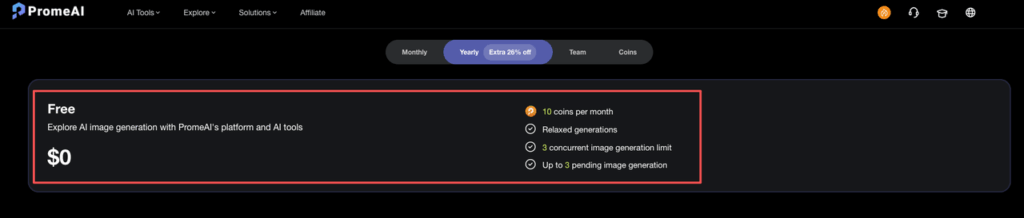
We tried running a full client moodboard on the Free tier just to see if we could cheat the system.
Short answer: you shouldn’t.
Here’s why:
- Coins (Current Snapshot): At the time of testing (Jan 2026), the Free tier offers approximately 10 coins/month. This limit is strictly enforced and designed for trial only.
- Usage: personal, non-commercial only
- Speed: relaxed (slower), up to 3 concurrent generations
- Rights: you cannot use outputs for anything profit-making
So if you:
- Pitch with it
- Use it in a paid project
- Print it on merch
…you’re outside the allowed use on Free.
You can prototype ideas, learn the interface, and test prompts. But for real client deliverables license coverage, Free is a hard no.
Official wording is on their commercial use page and terms, and both are very clear: Free/Base = no commercial use.
Pro tier rights
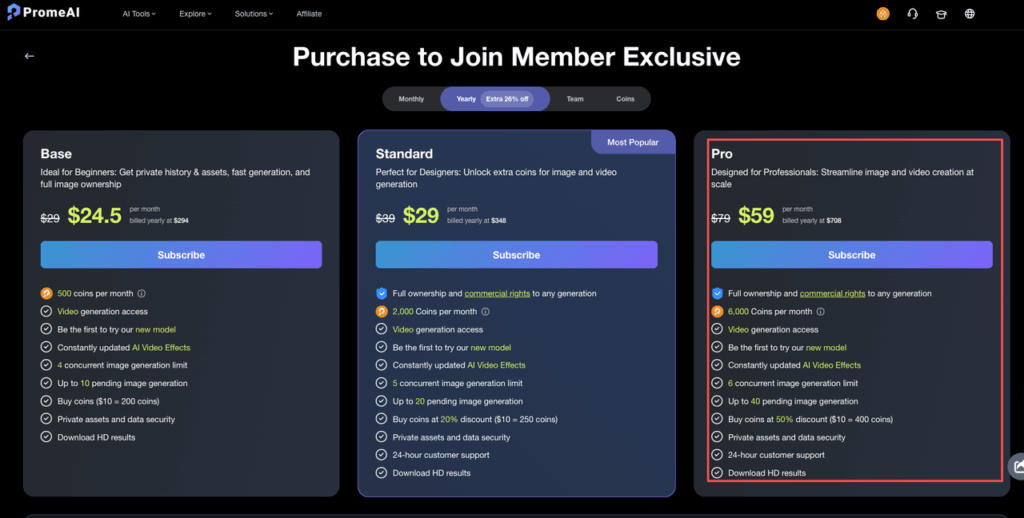
This is the tier most solo pros and small studios we know end up on.
From testing it across a week of real projects (architecture concept visuals and product mockups), this is what we’ve learned about Pro:
- Current Pricing (as of Jan 2026): Approximately $59–$79/month or $708/year
- 6,000 coins/month (plenty for regular studio use)
- Fast, detailed generations, with up to 40 parallel tasks
- Video generation access
- Discounts on extra coins (e.g., $10 for 1,000 coins)
- And the important part: full ownership and commercial rights for generated content
For promeai commercial use, Pro gives you the green light to:
- Use images in client decks, moodboards, pitch books
- Use in architecture promos (site banners, competition boards)
- Drop into social media campaigns, ads, landing pages
- Print in books, brochures, magazines
- Use in animations, storyboards, film frames
As long as you:
- Stay within the law
- Avoid prohibited content (hate, exploitation, clear infringement)
- Respect portrait/privacy rights when using real people
PromeAI doesn’t give you a warranty that your images are 100% clear of all risk. They explicitly say use is at your own risk in the terms. So we still do basic checks (no obvious logos, no celebrity look-alikes) before sending anything to clients.
Team tier rights
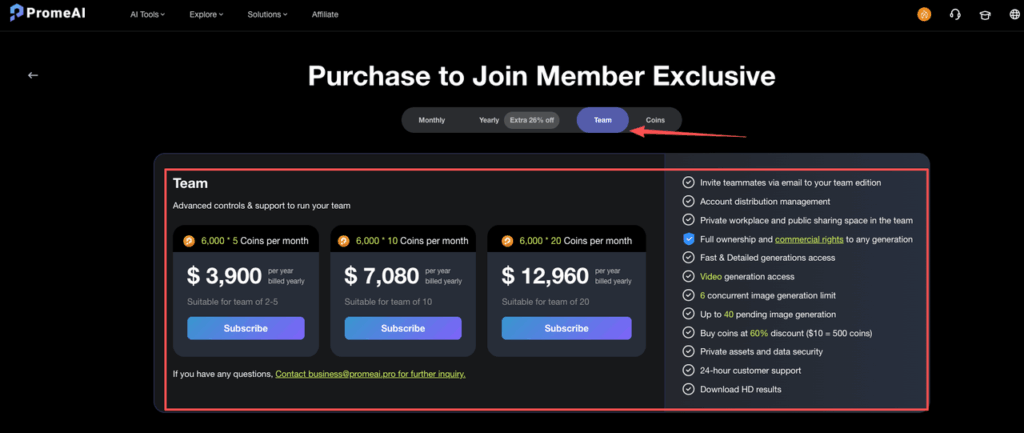
If Pro is “freelancer / tiny studio”, Team is “agency or in-house creative squad sharing one brain”.
What we’ve noticed using Team across 4 designers:
- Starts around $3,900/year for 2–5 users
- Includes all Pro rights (full ownership + commercial rights)
- Adds:
- Private workspaces for each user
- Shared spaces for team concepts
- Account / seat management
- Invite teammates via email for real-time co-creation
So for team plan commercial workflows, this is your safe base:
- Everyone on the account can generate for client projects
- Assets are manageable in a shared workspace
- You keep commercial rights across the board
If your studio has multiple designers touching the same AI boards, Team is far cleaner (and safer) than sharing one Pro login in a sketchy way.
Feature details change sometimes, so we cross-check pricing and features here: PromeAI member page.
What “Commercial Use” Means
“Commercial use” is where most of us start to sweat.
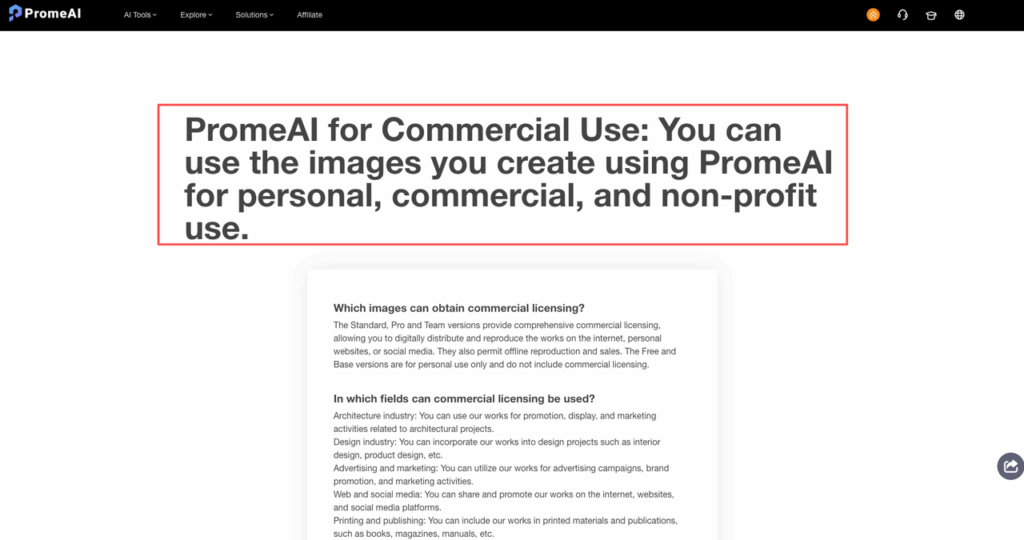
PromeAI defines it pretty simply: profit-making activities with their outputs, as long as you’re on a commercial tier (Standard/Pro/Team) and you follow the law.
From a practical design perspective, here’s how that breaks down.
Client projects: Yes
If you’re on Pro or Team, you can absolutely use PromeAI outputs for client work. That includes:
- Brand campaigns and marketing visuals
- Architecture competition boards and real-estate promos
- Interior design concepts and product mockups
- Web design hero images, blog headers, thumbnails
You can:
- Deliver them as final assets
- Use them as concept art or ideation boards
- Mix them into collages with your own 3D or photos
We treat PromeAI like any other creative tool (Photoshop, Blender, etc.), with one extra step: we clearly note in contracts that parts of the work are AI-generated. More on that later.
PromeAI’s commercial use page confirms that client projects are fine on a paid tier, as long as they’re legal and not breaking rights.
Resale: Conditions
This is where ai image rights get interesting.
According to PromeAI, if you’re on a commercial tier, you can reproduce, distribute, and sell the work:
- Online (websites, platforms, social media)
- Offline (prints, books, manuals, etc.)
That means you can:
- Sell AI-generated poster art
- License images as stock to clients
- Include images in a paid template pack or UI kit
But there are basic guardrails:
- Don’t include obvious third-party IP (e.g., Disney characters, actual logos)
- Don’t resell content that’s defamatory, harmful, or illegal
- Don’t imply a human photographed or drew something if that’s legally risky in your region
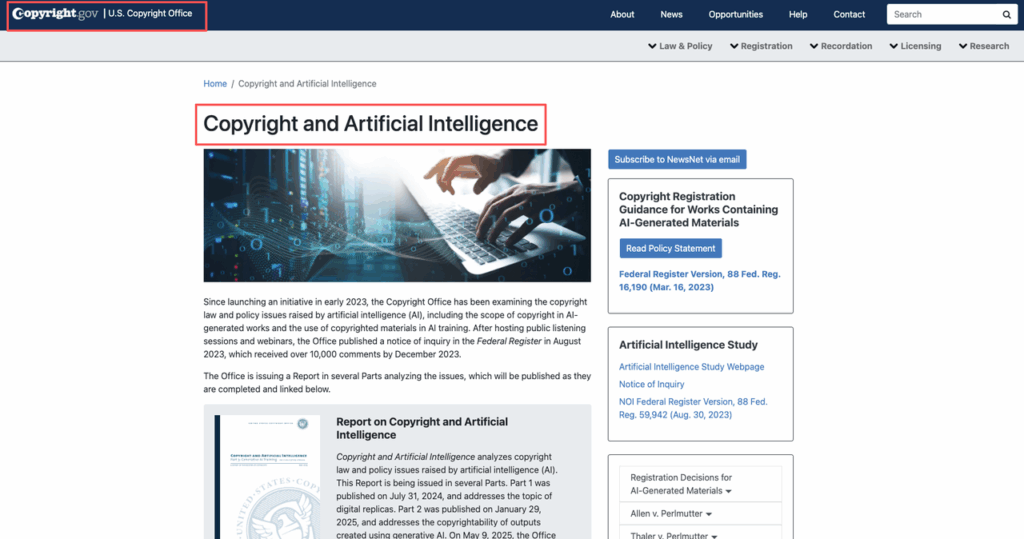
The US Copyright Office has a useful AI note here: copyright.gov/ai. It confirms that fully machine-generated images sit in a gray area for copyright protection, which is another reason we’re honest with clients about AI usage.
Merchandise: Guidelines
Good news for product designers and merch brands: PromeAI’s commercial tiers do cover merch.
You can use generated images on:
- Apparel (shirts, hoodies, hats)
- Posters, art prints, zines
- Book covers, manuals, packaging
We treat prompting like seasoning here: we generate a strong base image in PromeAI, then refine it in Photoshop or Illustrator, so the final piece feels more unique and less obviously “straight from the model”.
Key rules we stick to:
- Avoid faces unless you have written model releases
- No copyrighted characters, icons, or brand marks
- Avoid offensive or harmful themes (they can blow back on you legally and reputationally)
If you keep it original and clean, merch is fair game under Pro or Team.
Client Deliverables Checklist
Here’s the part we’ve baked into our client deliverables license process.
We literally run through this quick checklist before sharing anything AI-heavy.
Quick pre-delivery check:
- Are we on Standard/Pro/Team, not Free/Base?
- Does any image obviously copy a known IP or logo?
- Are there recognizable faces we don’t have rights for?
- Is the use clearly legal and non-abusive?
If we can say “yes, we’re clean” to those, we move to contracts.
What to include in contracts
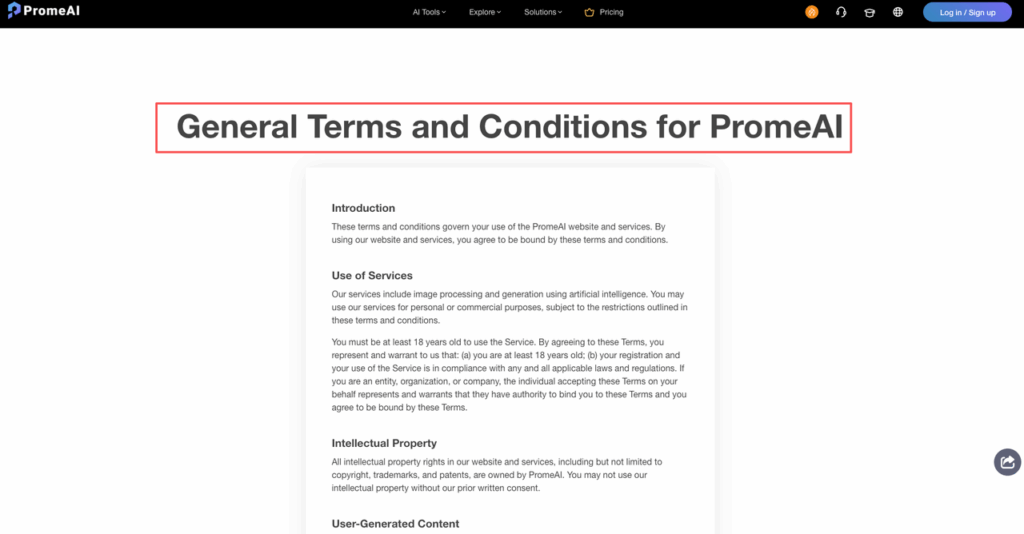
PromeAI doesn’t give a required contract template, so we’ve built our own language based on their terms and general IP practice.
Stuff we always include:
- AI disclosure clause
We state clearly that some assets were generated or assisted by AI tools (including PromeAI). Example:
“Portions of the visual content were generated using AI tools (including, but not limited to, PromeAI). We review and edit all outputs before delivery.”
- Ownership + license transfer
On commercial tiers, PromeAI gives us ownership of outputs, which we can pass to clients. We spell out whether:
- The client gets full ownership, or
- A commercial license with limits (e.g., territory, media, duration)
- Indemnification
Since PromeAI shifts liability to the user, we add a line that use is at the client’s risk once they approve and publish, and that they won’t repurpose the work for illegal or harmful activity.
- Portrait / personal data consent
If any generation involved a real person’s face or likeness, we add clauses about model releases and client responsibility for how they use that image.
We’re not lawyers, so when a project is high-stakes (big ad campaigns, wide distribution), we have legal counsel review our contract wording.
Attribution requirements
This part is easy.
PromeAI does not require attribution on any tier.
You don’t have to write “Generated with PromeAI” anywhere, even for commercial use.
We still sometimes add a tiny line like:
“Concept art generated with PromeAI and edited in-house.”
Why?
- It sets expectations with clients
- It’s transparent for end-users
- It can actually be a selling point when a client loves the speed
But again, attribution requirements are zero. It’s optional appreciation, not a rule.
Risk Notes & Edge Cases
Here’s where things get a bit less fun but way more important.
We’ve hit edge cases around AI before, so now we try to think three months ahead, not just to the deadline.
AI disclosure requirements
PromeAI doesn’t force you to disclose that outputs are AI-generated.
But law and platform rules are shifting fast. Some platforms and regions are starting to ask for AI labels on content, especially if there’s a risk of deception or misinformation.
Our rule of thumb:
- For clients: always disclose in the contract and explain what that means in plain language.
- For public work: if the piece could reasonably mislead someone (e.g., fake news-style photo), we add a small AI note.
Think of disclosure like seatbelts: annoying until the one time you need it.
Copyright considerations
This is the part most designers quietly worry about.
PromeAI says:
- On commercial tiers, you own the generated outputs
- You’re fully responsible for what you upload and generate
- You must not infringe on third-party IP rights
The US Copyright Office adds nuance: purely AI-generated images don’t get standard copyright protection the same way human-created works do (source).
So, how do we stay sane and safe?
We follow a few rules:
- We don’t upload client logos or heavy brand assets as prompts unless the client has approved it
- We avoid prompts like “in the style of [famous living artist]” in paid work
- We comb finals for obvious logo look-alikes or iconic characters
- High-risk domains (surveillance, weapons, harmful propaganda) are just a blanket no for us, even if the tool technically allows it
If an image looks a little too close to a known piece, we treat it like a design reference: redraw, repaint, or rebuild in our own style.
That way our ai image rights story stays clean, and clients aren’t exposed to ugly IP surprises months later.
If we had to boil all this down into one sentence, it’d be this:
Use Pro or Team for anything paid, write AI use into your contracts, and avoid anything that feels like copying or deception.
We’re curious: where do you usually get stuck with AI licensing in client work? Try PromeAI for free this week, and tell us if our contract checklist actually saved you time—or what we missed.
PromeAI Commercial License & Client Work FAQs
Can I use PromeAI Free tier for client work or paid projects?
No. The PromeAI Free/Base tier is for personal, non‑commercial use only. You can experiment, learn prompts, or prototype ideas, but you cannot legally use Free-tier outputs in pitches, paid client projects, merch, or any profit-making context. For client work, you need a commercial tier like Standard, Pro, or Team.
Which PromeAI plan should I choose for commercial license client work?
For reliable promeai commercial license client work, you should use a commercial tier such as Standard, Pro, or Team. Pro works well for freelancers and small studios; Team is better for agencies or multi-designer teams. These tiers grant ownership and commercial rights to use outputs in client projects, campaigns, and deliverables.
Does PromeAI Pro give me full commercial rights to client deliverables?
Yes. On PromeAI Pro, you get full ownership and commercial rights to generated outputs, subject to the law and platform restrictions. You can use images in decks, campaigns, websites, print, and video for clients. However, PromeAI provides no IP warranty, so you remain responsible for avoiding infringement and other legal violations.
How should I handle contracts when using PromeAI for client work?
When using a promeai commercial license for client work, include four things in your contracts: a clear AI disclosure clause, explicit ownership or license transfer terms, an indemnification section that shifts ongoing use risk to the client, and clauses around portrait/likeness rights if real people’s faces or data were involved in generating the images.
Can I sell PromeAI-generated images as merch or stock assets?
Yes, if you’re on a commercial tier you can reproduce and sell outputs as posters, apparel, book covers, stock images, or template packs. You must avoid obvious third‑party IP (logos, characters), harmful or illegal content, and misleading claims about authorship where local law requires transparency about AI-generated material.
Recommend Reads
Leave a Reply